WHAT WE'RE FIGHTING
DEVASTATION OF A PRECIOUS RURAL LANDSCAPE
Since June last year the Save Glen Lednock group has been campaigning against plans by the multi-national companies Low Carbon and SSE to develop the 19-turbine Glen Lednock and 12-turbine Glentarken wind farms respectively. The developments would include not only the turbines but nearly 30 miles of access roads and hardstanding areas, substations and a controversial Battery Energy Storage System.
This complex would industrialise an area of the Southern Highlands that has, so far, remained free from wind farm development, and is surrounded by the Loch Lomond and Trossachs National Park, two National Scenic Areas and many other protected Local Landscape Areas.
The 95 spinning blades of the turbines would be visible across a swathe of Scotland, up to 25 miles away, including Auchterarder, Comrie, Crieff, Gleneagles and Muthill – and many of Scotland’s most popular mountains, such as Ben Chonzie, Ben Ledi, Ben Lomond, Ben More, Ben Vorlich, and Schiehallion.
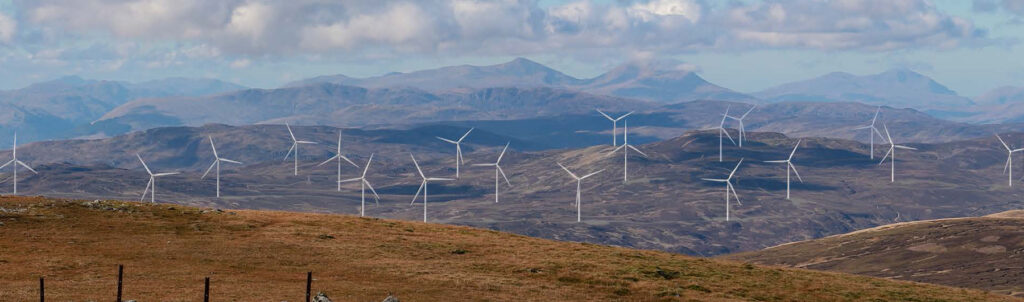
This extract from a Low Carbon visualisation of the view from Ben Chonzie – one of the most popular Munros in Scotland – shows that lovers of wild nature would be confronted by an industrialised landscape and the whirling distraction of serried ranks of tall wind turbines. And the extract (showing 19 of the planned turbines) does not include the further 12 turbines which would be constructed for Glentarken Wind Farm, immediately beyond the Glen Lednock Wind Farm.
Source: Glen Lednock Environmental Impact Assessment Report Volume 5 [Visualisations]: Figure 6.26. Viewpoint 6 Ben Chonzie.
SLAUGHTER OF ICONIC SPECIES
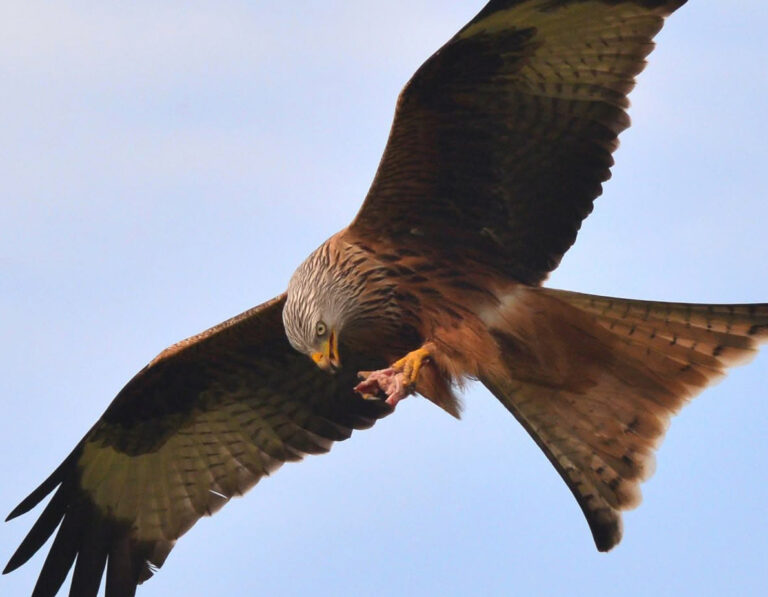
Not only would there be a damaging visual impact – Glen Lednock is an important habitat for birds of prey, including Golden Eagles, White Tailed Eagles and Red Kites.
Low Carbon’s modelling of the collision risk shows that hundreds of these iconic birds of prey would be killed over the lifetime of their wind farm. If adjacent Glentarken were also to go ahead, the cumulative impact on these protected species would be even greater.
MASSIVE TRAFFIC DISRUPTION, AND DAMAGE TO RURAL ROADS
The Glen Lednock Wind Farm would have a major impact on the A85 trunk road west of Perth and on other roads. The construction period of at least two years would involve up to 555 additional vehicles on the A85 per 10-hour working day (including 252 Heavy Goods Vehicles) – funnelling danger, noise and air pollution through Crieff, Cilmerton and Methven.
During construction, up to 200 ‘abnormal loads’ would be routed along a narrow lane, past primary and secondary schools, and beside Crieff’s beautifully-wooded MacRosty Park. These loads would include 57 movements of turbine blades up to 80m in length, necessitating brutal surgery of hundreds of mature trees – plus the severe traffic disruption caused by transporters crawling along at just 3mph.
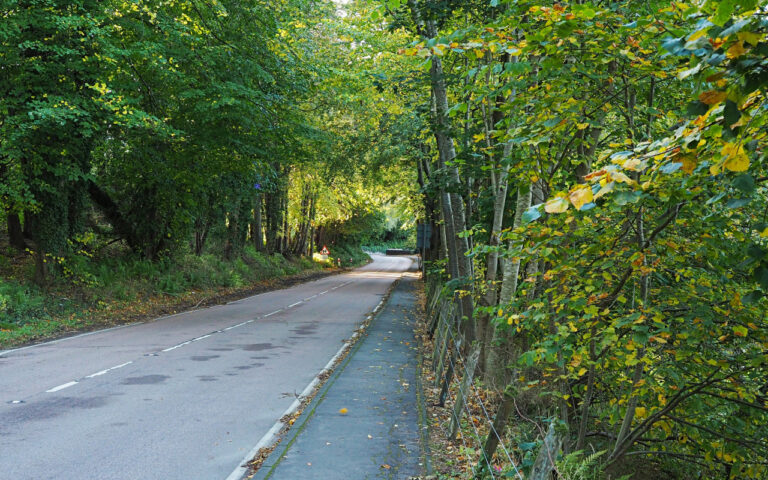
To accommodate 200 abnormal loads, the dense and delightful woodland along the A85 Comrie Road beside MacRosty Park in Crieff would be devastated by drastic surgery - or complete removal - of many mature trees.
‘The [Glentarken] proposal is contrary to National Planning Framework 4, Policy 4 (Natural Places) in that the site location, so close and prominent to the National Park boundary, will compromise the objectives of the designation. It is assessed that the significant adverse effects that the proposal will have upon the qualities for which the National Park has been designated are not outweighed by any social, environmental or economic benefits of national importance.’
NATURE SCOT
Read the Full Objection
UNDERMINING THE STRATHEARN ECONOMY
The proposed industrialisation of this precious mountain landscape – and other energy developments mooted along the iconic Highland Boundary Fault – threaten the long-term sustainability of the Strathearn and wider Scottish tourism industries, based as they are on unspoilt rural landscapes. Any benefit to the local economy during the construction period would be outweighed by damage to the tourist industry from the disruption and intrusion.
The claimed long-term benefits for local businesses would in practice be minimal, as wind farm operation and maintenance would be sub-contracted to specialist suppliers from outwith the area. Instead, we should be strengthening local resilience, not undermining it.
NOT ‘LOCALISED’
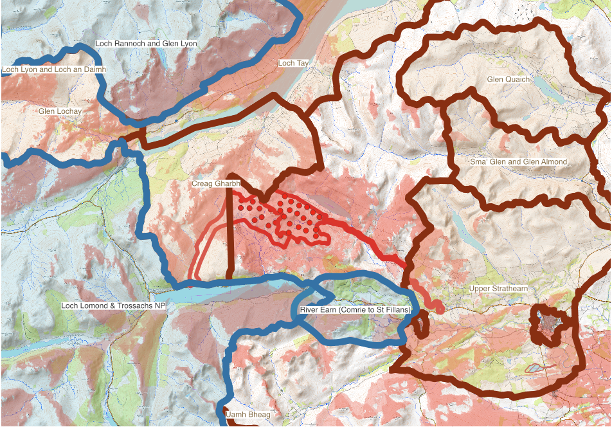
This map (below) of the ‘Zone of Theoretical Visibility’ shows (in shaded red-brown) the places in the immediate surrounding area where Glen Lednock and Glentarken turbines would be visible. Turbines would also be seen from many mountain and urban locations up to 25 miles away. The proposed new eight-mile access road to the Glen Lednock Wind Farm is shown in red, on the right, running north west from the A85 road just east of Comrie. Access to the Glentarken Wind Farm, on the left, would run north east from the A85 just east of Lochearnhead.
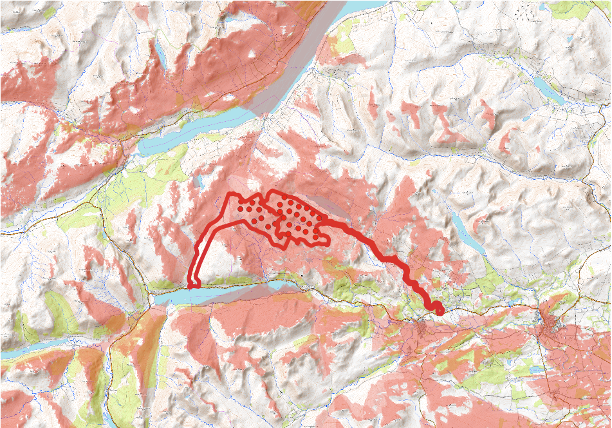
‘The two wind farms (shown below) would be surrounded by protected landscape areas: the Loch Lomond & the Trossachs National Park and three National Scenic Areas (all bounded in blue), and five Local Landscape Areas (all bounded in dark brown).’